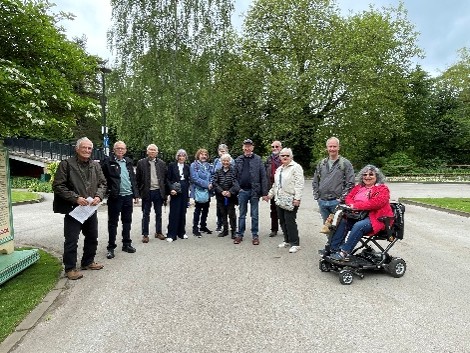
The newly formed Historical Heritage Group had their first visit to Chesterfield on Thursday, 21 May 2026. The mini-bus dropped us off at Queens Park, just off the town centre, where we had coffee and then started our walking tour of the town.
In 1886, the then Mayor of Chesterfield proposed that a public park be created to mark Queen Victoria's upcoming golden jubilee in 1887. However, it took the Local Government Board a further six years to agree on costs and the park was eventually opened to the public on 2 August 1893.It is a lovely open space in the town with a miniature railway, a lake (with ducks and geese), a bandstand, a cricket ground, a children's playground and restaurant.
Chesterfield Cricket Club was granted exclusive use of the grounds in February 1894, and the first game was played there on 5 May 1894.
There was an unusual incident during the County Championship match between Derbyshire and Yorkshire in mid-1946. After two overs were bowled in the Derbyshire first innings, Yorkshire captain Len Hutton asked for the length of the pitch to be measured. It was found to be 24 yards long, instead of the regulation 22 yards. The pitch was correctly reset, and the game continued.
We then walked into the town with our first stop at The Portland Hotel on Lower Pavement built in 1899 to serve the adjacent Market Place railway station. The Lancashire, Derbyshire and East Coast Railway opened in 1899. The line only went as far as Lincoln and terminated in Chesterfield. It closed to passengers in 1951 and the station was demolished in 1973.
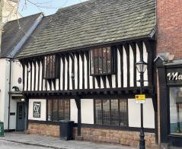
Further along the road is The Peacock which is now a café. It’s one of Chesterfield’s most complete late medieval buildings dating from 1500 and was thought to have been built as a Guildhall for one of Chesterfield’s 4 guilds.
Opposite the new market square stands Grace Chapel, built in 1867 for the Sheffield Banking Company. It echoes an earlier stone house on the site, typical of local buildings before the Chesterfield Canal opened in 1777 and made imported bricks and tiles more common. At the corner of Soresby Street, we paused to look at the Grade II listed former Post Office, which closed in 2014. Farther along is NatWest Bank, built in 1969, whose first-floor windows show scenes from the town’s historic industries and nearby stately homes. These streets once bordered the market place, where livestock was sold alongside the Saturday general market until a new cattle market opened in 1900. The Chesterfield Market Company was formed to fund a Market Hall, which opened in 1857 with butter and corn markets on the ground floor. The Corporation took over the building in 1873. Today, the lower floors house shops, while the assembly room and offices remain above.
We then turned into Glumangate, one of the town’s oldest streets. Its name is unique in Britain and is thought to refer to the Glee Men, or minstrels. The road leads to Saltergate, where ‘gate’ is the old word for road, and whose name reflects its use as the route by which salt was brought from Cheshire.
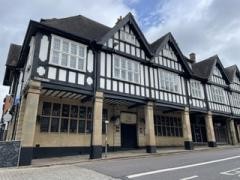
Our route then took us along Knifesmithgate, lined with 1930s black and white Tudor revival buildings. Its name combined ‘smith’ and ‘smithy’, reflecting the area’s historic role in making knives and tools. The colonnade was designed to shelter shoppers from the rain, and the grotesques at the top of the columns were originally covered in gold leaf.
On the same road stands the Premier Inn, built as the main branch of the Chesterfield Co-operative Society and once the town’s largest department store. Although hugely popular, falling demand led to its closure in July 2013. The first nonconformist chapel is in Elder Yard, a Grade II listed building dating from 1692–94. As we continued, I pointed out the Victoria, the billiard hall where future world champion Joe Davis began his career. It was also a popular place for courting, with its ballroom and cinema.
Turning into Holywell Street, we passed the Winding Wheel Theatre, which opened as a picture house in 1923 and later became the Odeon; an extension was added in 1932. Holywell Street formed the north-east boundary of medieval Chesterfield and was also the site of the town’s market in the 11th century.
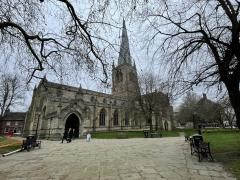
We then arrived at the Parish Church of St Mary and All Saints, known worldwide as the Crooked Spire. The earliest record of a church on the site dates from 1042, though it would have been much smaller than the present building. The font in the south transept is thought to date from between 890 and 1050. Construction of the current church began in 1234, but most of what survives today dates from the 14th century and is largely medieval. The church has a classic cruciform plan, with a nave, aisles, north and south transepts, and a chancel surrounded by four guild chapels. Much of its medieval decoration was lost during the Reformation in the 1500s. It was rebuilt in the 1700s and extensively restored by Gilbert Scott in 1843–44.
In 1810, a peal of 10 bells was installed in the steeple beneath the spire, and in quieter times could be heard up to four miles away. In 1817, an inspection found loose, rotting timber inside the spire and signs that internal beams were pushing the structure southwards, leaving it in danger of collapse. Although dismantling the spire was recommended, it was ultimately repaired instead.
On 11 March 1861, the church spire was struck by lightning, damaging gas lighting pipes in the steeple and igniting a beam next to the wooden roof of the chancel. The fire smouldered for three and a half hours until it was discovered by the sexton on his nightly round to ring the midnight bell. A further fire erupted on 22 December 1961, this time engulfing the north of the church. A clerk at the town library noticed smoke from the north transept window and raised the alarm, enabling firefighters to save much of the historic church, including the south transept screen from c. 1500, the Norman font and a Jacobean pulpit – but the flames melted the glass in the north window and destroyed the roof, the choir room, and the majority of a rare 1756 John Snetzler pipe organ.
In 1984, to mark the church's 750th anniversary, new stained-glass windows depicting the town's history from the 11th century onward were installed in the south aisle, a gift from the people of Chesterfield.
The spire was added around 1362 and rises 228 feet (69 m) above the ground. It is both twisted and leaning: its 45-degree twist leaves the tip 9 ft 6 in (2.9 m) off centre. The exact cause remains uncertain, but possible explanations include a shortage of skilled workers during the Black Death, insufficient cross-bracing, the use of green (unseasoned) timber, and the 17th-century addition of 33 tons of lead sheeting to 14th-century bracing not designed to carry such weight. Another theory suggests that sunlight heated the south side more than the north, causing unequal expansion. The distortion may result from a combination of these factors.
At the top of the spire, the golden cockerel weather vane bears the names of St Mary’s past vicars. The church’s twisted spire gave Chesterfield F.C. its nickname, the Spireites, and it also appears on the club’s crest. Local businesses have used the spire in their branding too, including Chesterfield’s Scarsdale Brewery, which featured it in its logo from 1866 until Whitbread took over in 1958.
Those are the scientific explanations for the twisted spire, but local folklore offers other ideas - many of them involving the Devil. In one tale, a blacksmith from Bolsover accidentally drove a nail into the Devil’s hoof, causing him to leap over the church and kick the spire out of shape. Another says the Devil was perched on the spire when the smell of incense made him sneeze so violently that it warped. A third claims he stopped there while flying from Nottingham to Sheffield, wrapped his tail around the spire, and twisted it when the bells startled him into flight. Yet another suggests the weather vane bent under his weight, distorting the spire with it.
Another legend says the spire bent down to admire the beauty of a bride and became stuck in its twisted position. A variation claims the church was so astonished to witness a virgin marriage—whether bride or groom—that the spire turned to look and never straightened. According to the tale, it will return upright only when another such wedding takes place.
Whatever story you prefer, the truth is that the Crooked Spire has become a major tourist attraction.
When we visited the church, a lunchtime concert was underway, so some of our group stayed to rest and listen.
Other notable buildings include the Burton Buildings, now occupied by Greggs. Meshe Osinsky arrived in Chesterfield in 1911, changed his name to Montague Burton, and founded Burtons. When the store opened, it was the town’s largest and most modern shop. Nearby is the Shambles, which still follows the layout established around 1200 when the new market place was created. We also passed the Royal Oak, where butchers once slaughtered cattle on site, with blood running through open drains in the centre of the passage, now covered by oblong slabs. The timber-framed part of the Royal Oak originally housed two butcher’s shops and was heavily restored in the 1890s, when it was joined to the brick-built section.
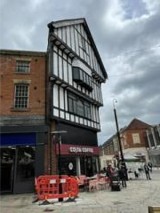
The former John Turner’s department store built in 1925 when Tudor Revival buildings were popular. A second story was planned but never built apart from the corner. It’s now Costa Coffee!