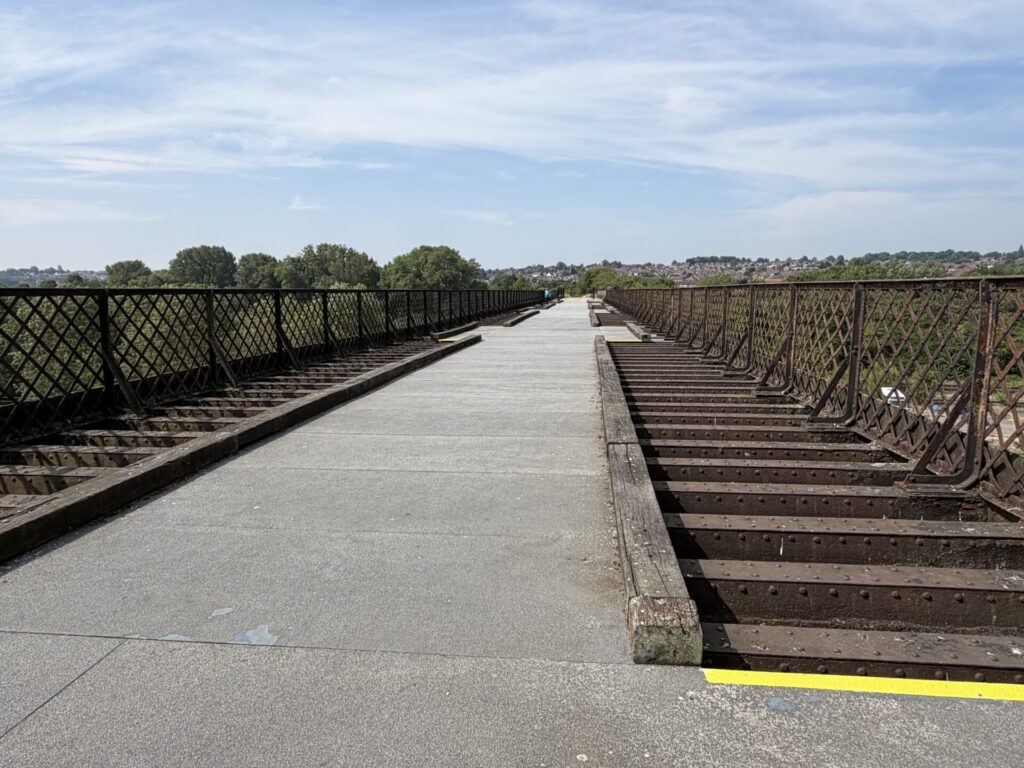
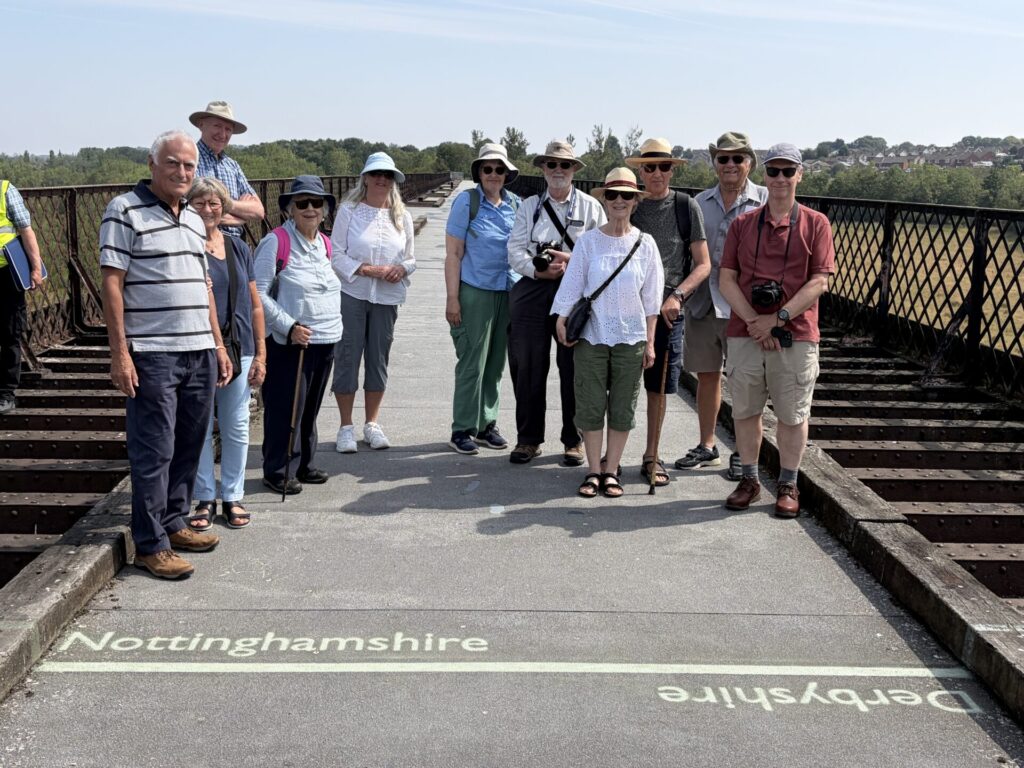
The Historical Heritage Group visited Bennerley Viaduct and the Industrial Museum at Wollaton Park on Thursday, 16 July 2026. The group of twelve went on the outing by minibus.
On arrival at the Viaduct we had a guided walking tour led by two of their volunteers who were very knowledgeable and explained the history of why and when it was built, with a few anecdotes along the way.
In the mid-1800s, private railway companies owned the rail network, with the Midland Railway dominating the region. Influential coal owners in the Erewash Valley wanted to challenge this monopoly because Midland controlled transport costs, raising coal prices and making the Erewash Valley Coalfield less competitive in the lucrative southern markets.
East of the Erewash Valley, the 10th Duke of St Albans owned millions of tons of coal reserves on his Bestwood Estate but lacked railway access to exploit them. As a powerful politician, privy councillor in Gladstone’s government, and influential public figure, he played a key role in securing Parliamentary approval for the new line in 1872.
Although the Midland Railway was based in Derby, local businesses and councillors believed its monopoly was restricting the city’s growth. By controlling the cost of goods entering and leaving Derby, Midland hindered trade, prompting businesses and councils to lobby Parliament for another railway company to serve the city. Derby was so determined to break Midland’s control that it allowed the Great Northern Railway to build its line through the city centre at Friargate.
Finally, in 1872, an Act of Parliament authorised the Great Northern Railway Company (GNR) to build the Derbyshire and Staffordshire Extension, also known as the Friargate Line. The route ran from Nottingham to Derby and then on to Egginton Junction in Staffordshire, with branch lines extending north into the Erewash Coalfield.
The construction of the line provided a significant engineering challenge as the easy geographical routes had already been taken.
GNR appointed Richard Johnson, Chief Civil Engineer, and Samuel Abbott, resident engineer, to design the line and its structures, including the viaduct. These innovative engineers met the construction challenges with ingenuity that reflected the spirit of the age.
The greatest challenge was crossing the Erewash Valley between Awsworth and Ilkeston, where extensive mine workings made a traditional brick viaduct unsuitable. To reduce the load on the foundations, the engineers designed a structure that was both light and flexible.
The viaduct was built and assembled by Benton and Woodiwiss, a well-known Derby-based railway construction company. The firm had earned a national reputation for building railways, tracks, embankments, bridges, viaducts, and tunnels as Britain’s rail network expanded across the landscape. It also worked on key sections of the internationally renowned Settle to Carlisle railway.
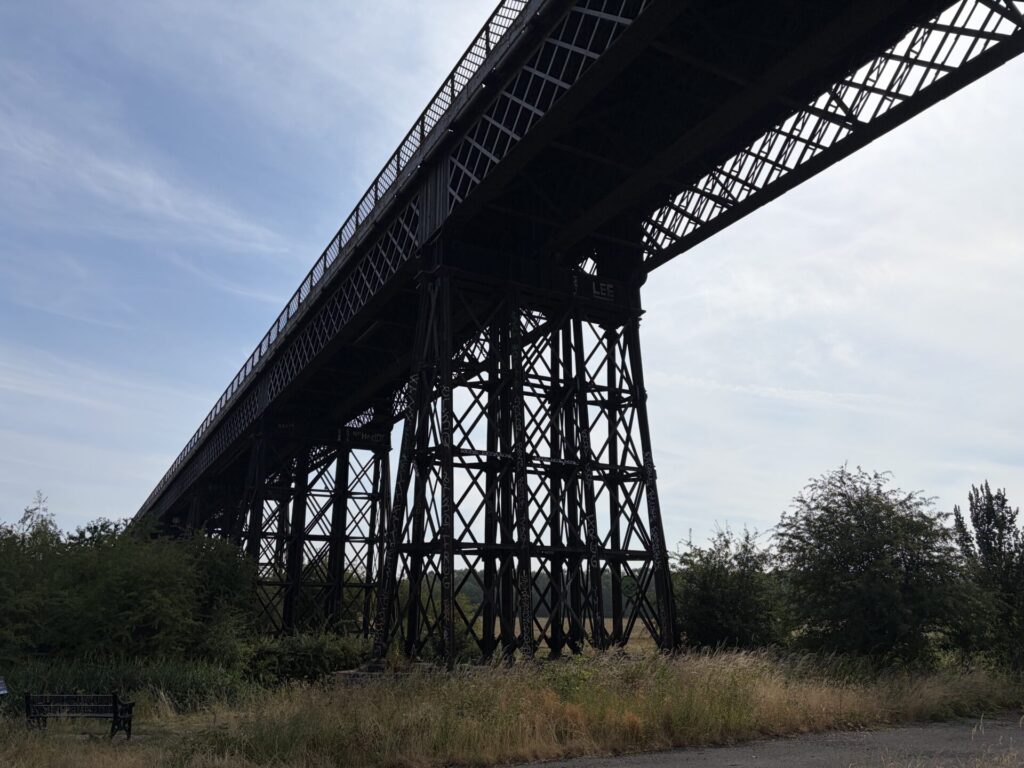
The viaduct was described to us as being like a giant Meccano set. All its wrought and cast iron components were locally sourced, fabricated in Derby, transported to Bennerley, and assembled on site using more than half a million rivets. Some of the bricks forming the pier bases also bear a Derby stamp. The large cast iron base plates, wrought iron piers, and trusses were made by Eastwood and Swingler, a Derby-based ironworks company that supplied railway ironwork around the world.
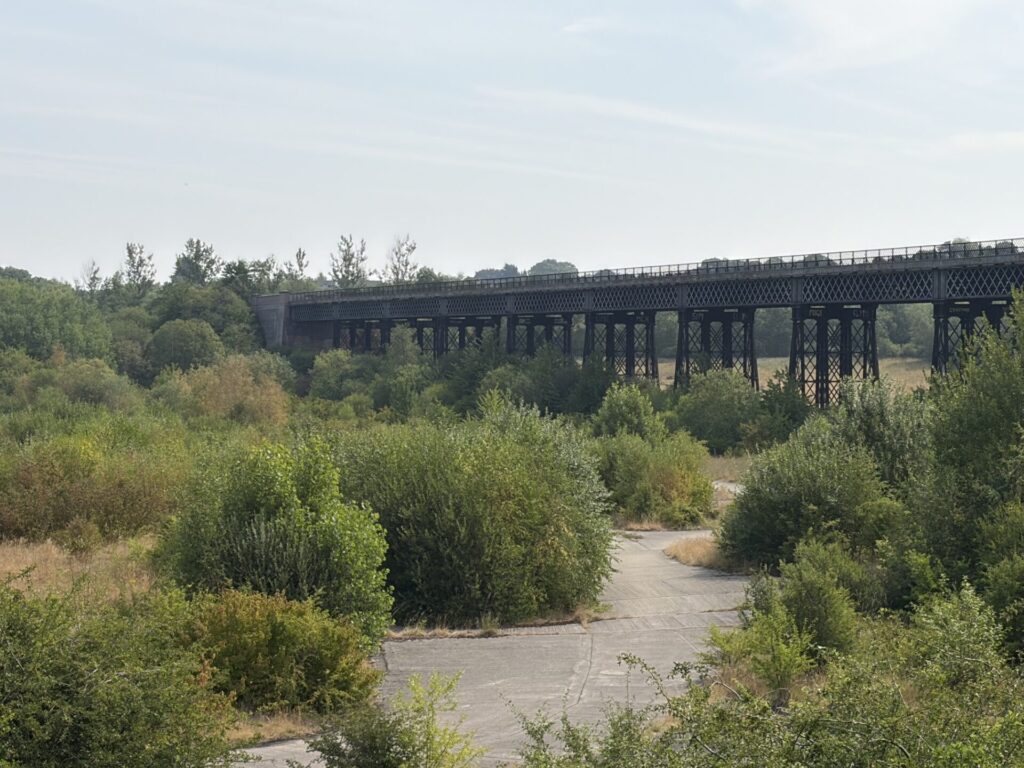
This Grade II* listed structure is 1,452 feet long, with its rails 60 feet 10 inches above the River Erewash, and has remained largely unchanged since it was built. It is the longest wrought iron viaduct in the British Isles, with Meldon Viaduct in Devon the only other surviving example in the UK.
Pier bases: The viaduct rests on brick pier bases. Because it sits on a 1:100 gradient, each base is a different height, with the Awsworth end standing 15 feet higher than the Ilkeston end.
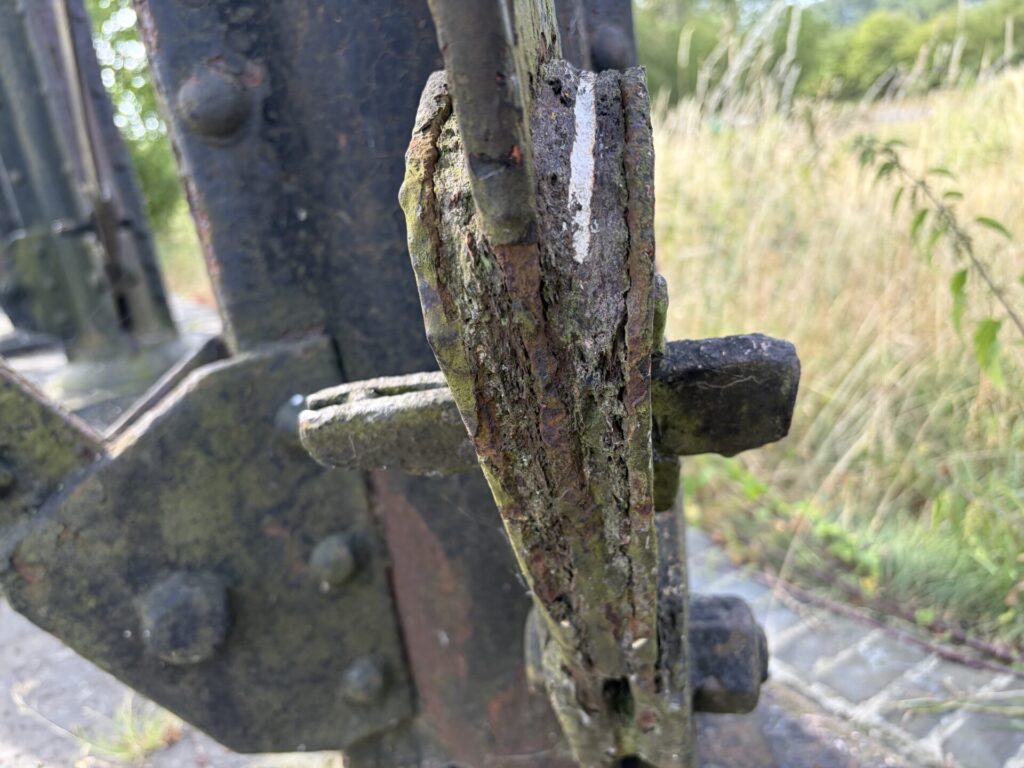
Base plates: The structure effectively “floats.” Four large cast iron base plates rest on top of each brick pier base. They are not fixed to the bases in any way but are held in place by gravity alone.
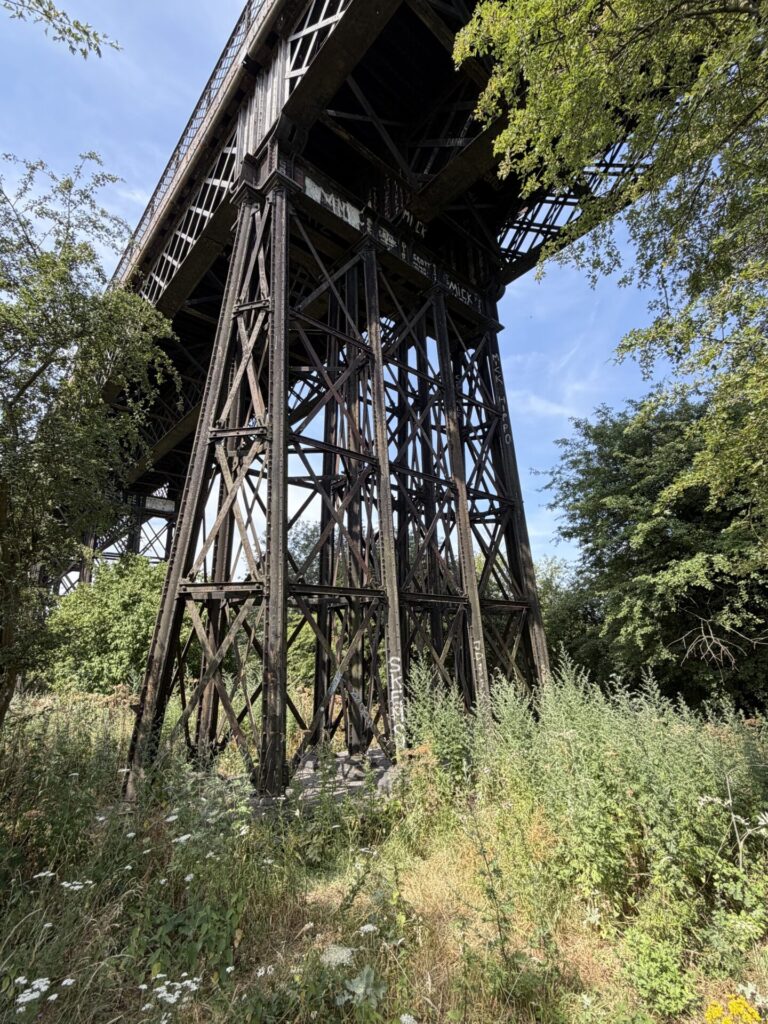
Columns: Twelve wrought iron columns, attached to the cast base plates, support the deck. Each hollow column is made from riveted wrought iron quarter sections and held in place by horizontal and diagonal bracing tensioned with cotter pins. More than half a million rivets were used to build the viaduct.
Deck: The deck of the viaduct consists of 526 transverse iron troughs which were filled with ballast. The sleepers which carried the railway lines were laid in the troughs. The track and most of the ballast has been removed.
Spans: The viaduct has 19 spans in total. Three spans cross over the Midland Railway. These spans are supported by brick piers. There are 16 further spans crossing the valley supported by 15 wrought iron piers.
The iconic Bennerley Viaduct was built over 18 months from 1877 and opened in January 1878, remaining in use for the next 90 years. The line carried goods trains transporting coal, iron, and beer, as well as passenger services linking local people with Nottingham and Derby. It also brought Skegness within reach, with thousands travelling to “Skeggy” on bank holidays for a day trip costing 13s 6d (67p).
The 1963 Beeching Report recommended closing the line for economic reasons, and the last passenger train crossed the viaduct in 1964. The final goods train followed in 1968, and the tracks were removed the next year, leaving the viaduct closed and without a purpose. British Rail, now responsible for a costly liability, sought tenders for demolition. However, its wrought iron construction was difficult to cut with conventional equipment and had little scrap value, making demolition prohibitively expensive. British Rail applied to Broxtowe and Erewash Borough Councils for permission to demolish the viaduct in 1975 but was refused. In 1980, the proposal went to a public inquiry, where local people, councils, and special interest groups argued that the viaduct was an important part of the country’s industrial and railway heritage. The community proposed repurposing it as a walking and cycling trail, and Environment Secretary Michael Heseltine requested a feasibility study, giving the “iron giant” a temporary reprieve. The Bennerley Viaduct Preservation Trust was formed soon afterwards and, for nearly two decades, promoted the vision of reopening the viaduct while successfully resisting calls for its demolition.
Following railway privatisation in 1998, ownership of the viaduct passed to Railway Paths Ltd, a sister charity of Sustrans. More than 200 miles of former trackbed and over 700 railway structures were transferred to RPL, with the expectation that these routes would become part of the emerging National Cycle Network.
In 2015, Sustrans secured a £40,000 Heritage Lottery Fund grant for “Rediscovering Bennerley Viaduct,” a project designed to engage the community and gauge support for reopening the viaduct as a walking and cycling trail. Strong local support led to the formation of the Friends of Bennerley Viaduct (FoBV). In 2017, Sustrans and FoBV developed an £8.3 million proposal to restore and repurpose the viaduct, with funding sought from the Heritage Lottery Fund (HLF).
The Heritage Lottery Fund assessed the project favourably, but the first bid narrowly failed to secure funding. HLF considered it a priority and recommended resubmission. Although Sustrans initially planned to submit a revised application, concerns over match funding led it to withdraw. In February 2018, Sustrans decided not to continue the project and returned responsibility for future work to the owners, Railway Paths Ltd.
Since March 2018, the Friends of Bennerley Viaduct have worked closely with Railway Paths on a phased project to protect the viaduct for future generations.
The new Visitors Centre and Café opened on Saturday, 18 July 2026 and the volunteers are hoping to offer tours at weekends.
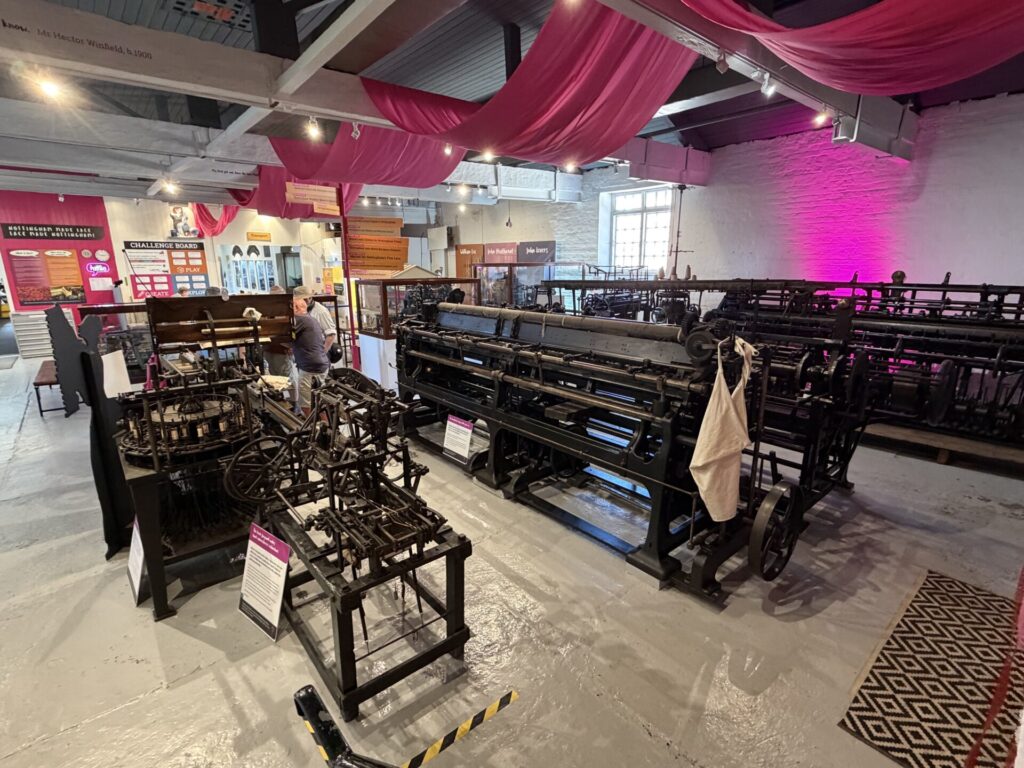
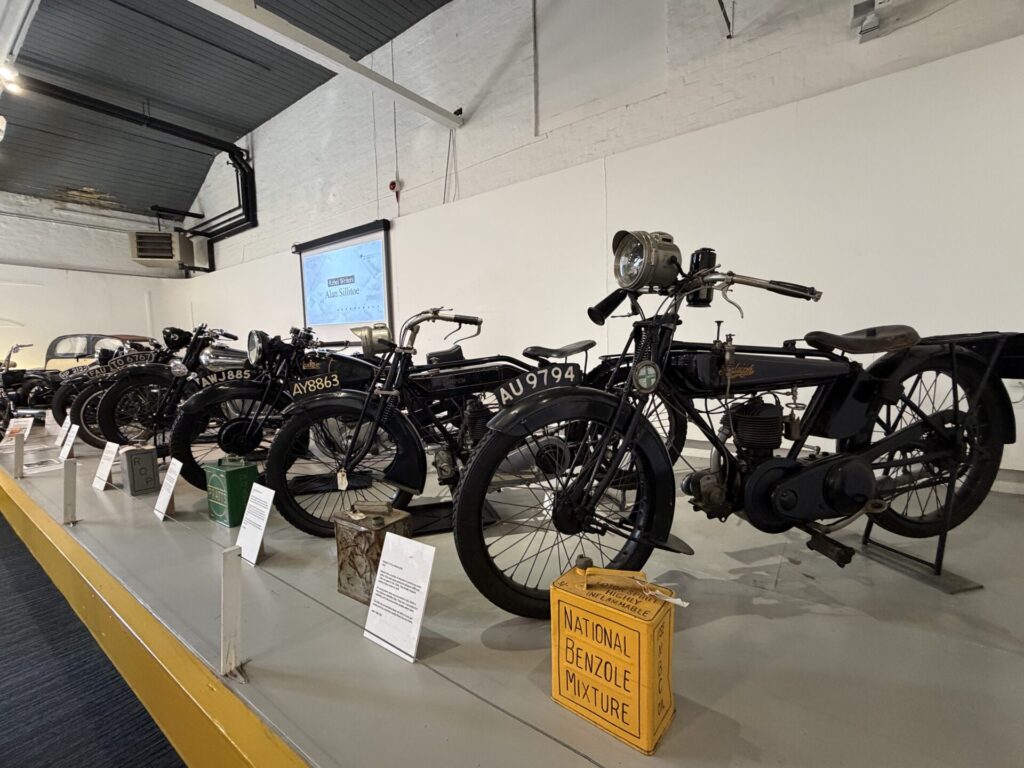
After lunch we continued our outing at the Nottinghamshire Industrial Museum in Wollaton Park. The Museum has a fascinating collection which explores the rich industrial history from The Industrial Revolution to the early 20th century.
The exhibits cover the railway, bicycle, motorcycle, lace, telecommunications, pharmaceutical, and tobacco industries, featuring well-known names such as Raleigh, Brough, Players, Boots, Humber, and Reader. The museum also has working steam and diesel engines, a Victorian kitchen, a forge, and a woodworking shop. Run by volunteers, it included a demonstration of a lace-making machine and examples of the lace it produced.